01 Starting point
A commercial vehicle dealer does not run its inventory in the web alone. Purchasing, reconditioning, paperwork, appraisals, pricing and sales all hang off the same vehicle data. If that data is kept in spreadsheets, file folders and the CMS in parallel, it drifts apart — and then the question arises which version of a record actually counts.
Standard software rarely fits here. An articulated truck with a swap body follows a different field logic than a passenger car record from an off-the-shelf solution; missing fields end up as free-text notes nobody can evaluate. Then there is the nature of the used heavy commercial vehicle market: it is an export business. Buyers sit in Poland, Spain or the Russian-speaking world. The inventory has to go out in several languages — without anyone maintaining five versions of the same vehicle.
02 Solution
etruck is an in-house development. The system holds the vehicle inventory with all its attributes, images and documents in one place. Each vehicle moves through a status from arrival via reconditioning to sale. The data model follows commercial vehicle logic — axle configuration, body, mileage, first registration, condition — rather than the lowest common denominator of a standard product.
The application runs on the house PHP stack: PHP 8, MariaDB as the database, Redis for caching and sessions, running in containers on our own servers in Germany. There is no public access — etruck is an internal tool and is built around roles and permissions accordingly.
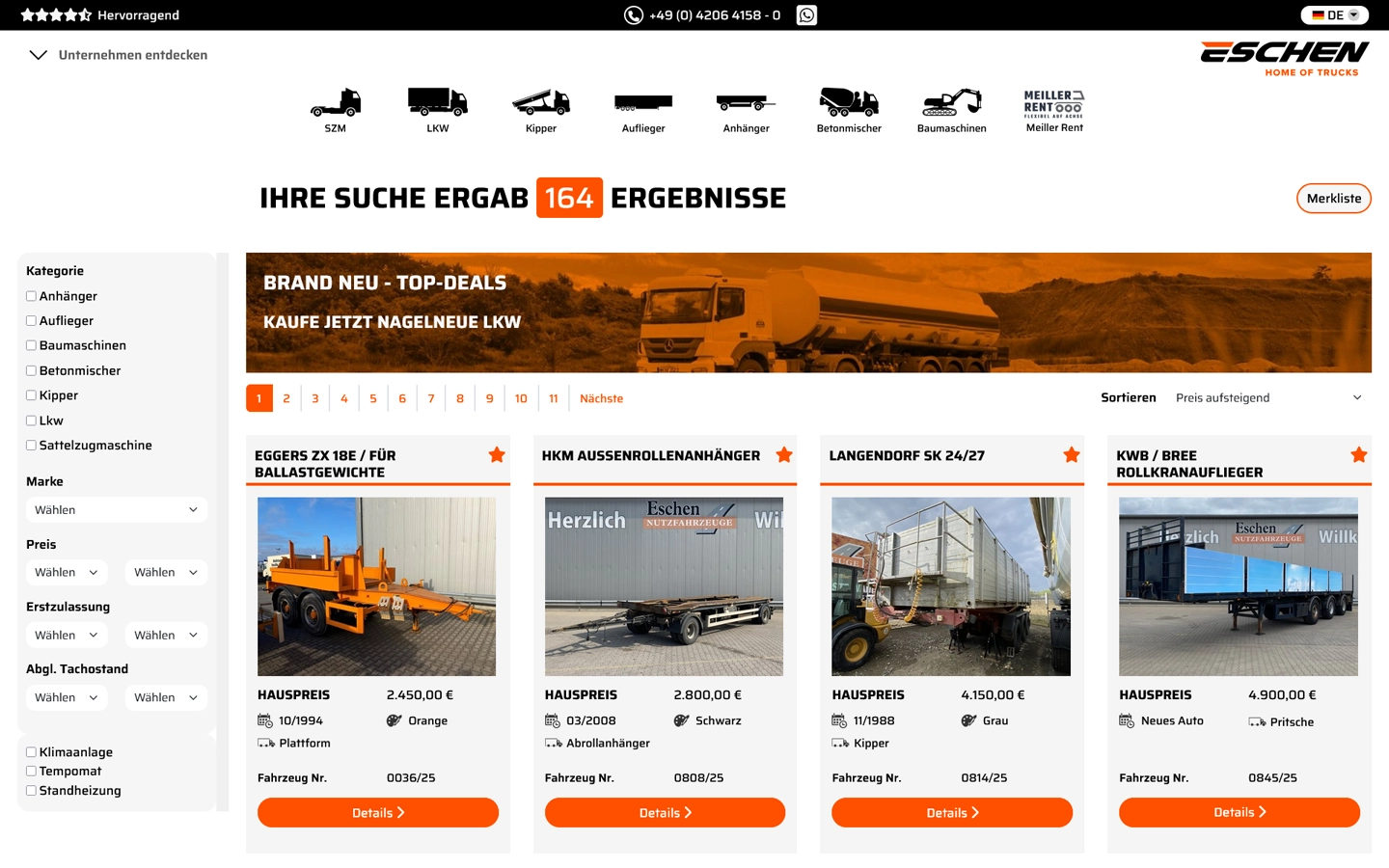
An interface connects it to the website. Released vehicles are handed to TYPO3 with technical data and images; blocked or sold ones disappear there automatically. The cut pays off in the multilingual setup: first registration, mileage, engine output and images are language-neutral and appear in all five language versions without being entered a second time. Only what is genuinely text gets translated. Everything is maintained in the authoritative system — the website is an output channel, not a second data store.
03 Result
The inventory has one authoritative source. What applies internally is what appears externally. Reconciling the sales list against the website is no longer a task of its own, nor is hunting for the current version of a vehicle record or a document.
Reach into the export markets costs no additional upkeep. A vehicle is entered once and is visible in five language versions — the effort grows with the inventory, not with the number of languages.
Because data model, application and interface were all built in the same place, new fields, reports or additional output channels can follow without waiting for another vendor’s release cycle.